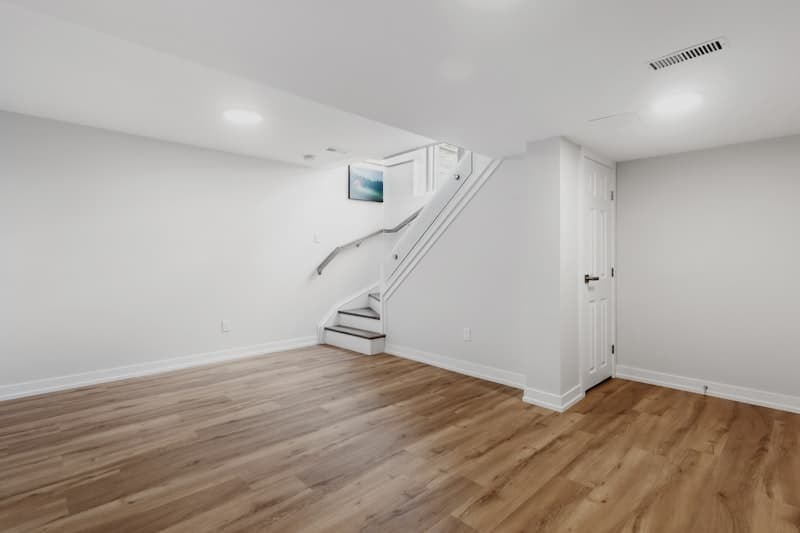
Why Hamilton Homeowners Are Converting Basements Into Home Offices
Remote work is not a trend in Hamilton Township — it is how a significant portion of the population works now. Hamilton sits along the Route 1 corridor between Princeton and Trenton, an area dense with professionals who work hybrid or fully remote for state government, pharmaceutical companies, financial firms, and tech employers. For these homeowners, "home office" stopped meaning a laptop on the kitchen table around 2020 and never went back.
The problem is space. Hamilton's housing stock — Cape Cods, ranches, and split-levels built from the 1940s through the 1970s — was not designed for a dedicated home office. Bedrooms are small. Living areas are shared. The kitchen table gets reclaimed for dinner. But underneath all of these homes sits 500 to 1,200 square feet of basement that is doing nothing except storing Christmas decorations.
A basement home office conversion is not the same as general basement finishing. It is a purpose-built workspace designed around the specific needs of someone who works from home full-time: dedicated electrical circuits, climate control, soundproofing, proper lighting, and connectivity. This guide covers exactly what that involves in Hamilton Township — including NJ building code requirements, costs, design decisions, and whether a basement office makes more financial sense than renting commercial space.
For general basement finishing information, see our comprehensive basement finishing guide for Hamilton NJ. For cost details on full basement build-outs, see our basement finishing cost guide for NJ.
Hamilton's Housing Stock Is Built for This
Not every home is a candidate for a basement office. Hamilton's homes — particularly those in Mercerville, Hamilton Square, Yardville, White Horse, and Broad Street Park — are excellent candidates because of how they were built.
Cape Cods and Ranches (Mercerville, White Horse, Yardville)
Hamilton's postwar Cape Cods and ranches sit on full basements with poured concrete or block foundations. Ceiling heights typically range from 7 feet to 7 feet 6 inches — enough for a comfortable office space. These basements are accessed from an interior staircase, usually from the kitchen or hallway, and the mechanical systems (furnace, water heater, electrical panel) are clustered in one area, leaving 60-70% of the basement floor plan available for build-out.
Office conversion advantage: A dedicated office carved from the far end of a Cape Cod basement — away from the mechanicals and the staircase — gives you a genuinely private workspace without leaving the house. The concrete walls provide natural sound isolation from the living space above, and the below-grade temperature stays cool in summer and stable in winter.
Split-Levels and Bi-Levels (Hamilton Square, Broad Street Park)
Hamilton's split-levels are arguably the best candidates for a basement home office because the lower level is partially above grade. This means existing windows that let in natural light — a critical factor for a productive workspace. Many split-levels also have a separate exterior entrance from the lower level, which gives you a dedicated office entrance independent from the main living space.
Office conversion advantage: Natural light, potential separate entrance, generous ceiling heights (7 feet 6 inches to 8 feet), and a layout that already separates the lower level from the living space. In a split-level, the basement office feels like a separate professional space, not a cave under the house.
Newer Construction (Hamilton Crossings, Town Center)
Newer Hamilton homes built in the 1990s-2010s have basements with 8 to 9-foot ceilings, modern electrical panels, and better initial damp-proofing. These basements convert to office space more easily because the infrastructure is already closer to what a home office needs.
Office conversion advantage: Taller ceilings, modern systems, and typically a more open floor plan that gives more flexibility in office layout and design.
Design Requirements for a Productive Basement Home Office
A basement office that actually works requires deliberate design decisions that go beyond drywall and carpet. These are the systems that separate a real home office from a desk in the corner of an unfinished basement.
Lighting
Natural light is the single biggest factor in workspace productivity and well-being. In a basement, getting enough light requires intentional design.
Window strategy: - Split-levels: Existing above-grade windows may provide adequate natural light. Clean them, remove any exterior obstructions, and consider enlarging them or adding additional windows if the layout allows. - Cape Cods and ranches: Below-grade basements have small hopper windows that provide minimal light. Install larger egress-sized windows with window wells — not because code requires them for an office (it does not), but because the natural light transforms the space. - Window well design: Use oversized window wells with white or light-colored liners and gravel bottoms. They reflect more daylight into the basement than standard galvanized wells.
Artificial lighting plan: - Ambient: Recessed LED can lights on dimmers, spaced 4-6 feet apart, providing even overhead illumination. Target 50-75 foot-candles at desk height — bright enough for focused work without harshness. - Task: A dedicated desk lamp or under-cabinet light for concentrated work. Task lighting should be independently controlled from ambient lighting. - Color temperature: 4000K-5000K (neutral to cool white) for a productive daytime feel. Avoid warm 2700K lighting in a workspace — it signals relaxation, not focus. Consider tunable LED panels that shift from cool during the day to warm in the evening.
Electrical
A home office has specific electrical needs that a general basement finishing plan may not address.
Dedicated circuits: - Minimum two dedicated 20-amp circuits for the office area — one for computer equipment, one for general outlets and lighting - A third dedicated circuit for supplemental heating or a space-specific mini-split if the HVAC plan calls for it - Separate circuit for a laser printer or other high-draw equipment
Outlet placement: - Outlets at desk height (26-30 inches) in addition to standard baseboard height — eliminates cable clutter and extension cords - Floor outlets if the desk is positioned in the center of the room (not against a wall) - USB-C integrated outlets at the desk location for charging devices - At least one outlet on the circuit behind the desk for UPS (uninterruptible power supply) — critical for anyone who cannot afford to lose work during a power flicker
Data and connectivity: - Run Cat6A ethernet cable from your router location to the office — do not rely on Wi-Fi for a professional workspace. Wi-Fi degrades through concrete and framing, and a basement is the worst location in the house for wireless signal. - Install at least two ethernet drops at the desk location — one for the computer, one for a VoIP phone or secondary device. - If your router is on a different floor, run cable through the wall cavities rather than surface-mounting. The investment is minimal during a build-out and looks professional. - Consider a dedicated Wi-Fi access point in the office for tablets and phones, hardwired back to the router via the ethernet run.
HVAC and Climate Control
A basement office needs independent or supplemental climate control. The temperature that keeps a storage basement comfortable is not the same temperature that keeps a person productive for eight hours.
Options for Hamilton basements:
Ductwork extension from existing HVAC ($1,500-$3,500): The most common approach. Extend a supply duct and return duct from the existing system to the office area, with a zone damper or inline duct fan to control airflow independently. Works well when the existing system has capacity — which most Hamilton residential systems do, since the basement was an unconditioned space that the system was not previously heating or cooling.
Ductless mini-split ($3,000-$6,000 installed): The premium option and the best choice for a serious home office. A ductless mini-split gives the office its own thermostat, its own heating and cooling, and zero dependence on the rest of the house. It is energy-efficient, quiet, and provides precise temperature control. In Hamilton's climate — cold winters and humid summers — a mini-split handles both extremes.
Electric baseboard or wall heater ($500-$1,500): The budget option for supplemental heat only. Handles NJ winters but does nothing for summer humidity and cooling. Only appropriate as a backup or for offices used primarily in cooler months.
Dehumidification: Every Hamilton basement office needs humidity control. Target 40-50% relative humidity for comfort and to protect equipment. A whole-basement dehumidifier ($1,500-$2,500 installed) or the dehumidification mode on a mini-split handles this. Do not skip this — a humid basement damages electronics, warps paper, and feels miserable to work in during July and August.
Soundproofing
If you are on video calls, in client meetings, or simply need concentration while the family is home, soundproofing the basement office is essential.
Floor-ceiling assembly (above the office): - Decoupled ceiling: resilient channel or sound isolation clips with hat channel, supporting a layer of 5/8-inch Type X drywall with Green Glue compound between layers. This breaks the direct connection between the floor joists above and the ceiling below, dramatically reducing footstep and impact noise. - Insulation: fill the joist bays above the office with unfaced mineral wool (Rockwool) — it is denser than fiberglass and significantly better at sound absorption.
Walls: - If the office shares a wall with the mechanical room (furnace, water heater), build a double-stud or staggered-stud wall with mineral wool insulation in the cavity. Furnace cycling and water heater ignition are the most common noise complaints in basement offices. - Exterior concrete walls provide excellent sound isolation by default — no additional treatment needed.
Door: - Solid-core door — not hollow-core. A solid-core door with weatherstripping on the frame and an automatic door bottom seal blocks a surprising amount of sound. - If maximum sound isolation is needed (recording, music, therapy practice), consider a second door creating a small vestibule or use a studio-grade acoustic door.
Cost of soundproofing: $2,000-$6,000 depending on the level of isolation. A decoupled ceiling with mineral wool and a solid-core door covers most home office needs.
Ergonomic Considerations
The physical design of the office space matters as much as the systems inside it.
- Ceiling height and desk position: Standard Hamilton basements have 7-foot to 7-foot 6-inch ceilings with beams and ducts that reduce clear height in certain areas. Position the desk in the area with maximum clear height. If a duct runs across the office area, route it against the wall rather than across the center of the ceiling — it looks better and preserves headroom where you sit.
- Flooring: LVP (luxury vinyl plank) or engineered hardwood with a chair mat at the desk. Carpet is tempting for comfort but inappropriate in a basement — it traps moisture and is a mold risk. LVP with an anti-fatigue mat at a standing desk area is the best combination.
- Window height: If you are installing new windows, position the sill height so the window is at or above seated eye level. A window at knee height does not contribute to the view from the desk and creates glare on the monitor.
NJ Building Code for Habitable Basement Space
Converting a Hamilton basement to a home office is a construction project that requires permits and must comply with New Jersey's building code (based on the International Residential Code with NJ amendments).
Key code requirements for a habitable basement room:
- Minimum ceiling height: 7 feet clear floor to ceiling. Beams, ducts, and soffits may project to 6 feet 8 inches minimum if they do not extend more than 12 inches below the ceiling plane.
- Egress: An egress window is required ONLY if the room is classified as a sleeping room (bedroom). A home office does not require an egress window, though we recommend installing one for natural light and emergency safety.
- Electrical: All outlets must be GFCI-protected (basement is considered a damp location under NJ code). Arc-fault protection is required on all 15 and 20-amp circuits serving the habitable space.
- Smoke and CO detectors: Required in the finished basement and at the top of the basement stairway.
- Stairway: Must be at least 36 inches wide with proper headroom (6 feet 8 inches minimum) and a handrail. Most existing Hamilton basement stairs meet code but may need a handrail upgrade.
- Waterproofing: Not explicitly codified as a separate requirement, but moisture control is implicit in the habitable space standards. No inspector will pass a finished basement with visible moisture intrusion.
Hamilton Township permit process: Submit plans to the Hamilton Township Building Department. Expect 2-4 weeks for approval. Inspections include framing, rough electrical, rough plumbing (if adding a bathroom), insulation, and final. The5thwall handles all permitting and inspections — you do not need to interact with the building department.
Hamilton Basement Home Office Cost: $15,000 - $35,000
The cost of converting a Hamilton basement into a home office depends on the size of the office, the level of finish, and the systems you include.
Basic Office Build-Out: $15,000 - $20,000
A functional, comfortable office in a section of the basement (150-250 square feet).
- Framing and insulation ($2,500 - $4,000)
- Drywall, taping, painting ($2,000 - $3,500)
- LVP flooring ($1,200 - $2,500)
- Electrical — dedicated circuits, desk-height outlets, recessed lighting ($2,500 - $4,000)
- Ethernet cabling ($300 - $600)
- Solid-core door ($300 - $500)
- HVAC duct extension ($1,500 - $3,000)
- Basic soundproofing — mineral wool in ceiling, solid door ($1,500 - $2,500)
- Permits and inspections ($300 - $600)
Premium Office Build-Out: $25,000 - $35,000
A high-end, fully equipped workspace (200-400 square feet) with premium systems.
- Everything in the basic build-out, plus:
- Ductless mini-split for independent climate control ($3,000 - $6,000)
- Upgraded soundproofing — decoupled ceiling, double wall at mechanical room ($3,000 - $6,000)
- Egress window for natural light ($3,500 - $6,500)
- Built-in cabinetry and shelving ($2,000 - $5,000)
- Half-bathroom addition for the office area ($8,000 - $15,000)
- Dehumidification system ($1,500 - $2,500)
- Premium lighting — tunable LED panels, task lighting ($1,000 - $2,000)
Premium with Separate Entrance: $30,000 - $45,000
For Hamilton split-levels with existing lower-level exterior doors, or any home where a separate entrance can be added:
- Everything in the premium build-out, plus:
- Exterior door upgrade or installation ($1,500 - $4,000)
- Walkway and exterior lighting ($1,000 - $3,000)
- Entry vestibule or mudroom ($2,000 - $5,000)
A separate entrance makes the office feel professional to visitors and completely separates work traffic from family traffic. In Hamilton's split-levels, this entrance often already exists and just needs upgrading.
Basement Office vs. Renting Commercial Space in Hamilton
The financial case for a basement office conversion is compelling when compared to renting office space in the Hamilton area.
Rental costs in the Hamilton / Mercer County market (2026):
| Office Type | Monthly Rent | Annual Cost |
|---|---|---|
| Co-working desk (WeWork, local) | $300 - $500 | $3,600 - $6,000 |
| Small private office (150-200 sq ft) | $800 - $1,500 | $9,600 - $18,000 |
| Office suite (400-600 sq ft) | $1,500 - $3,000 | $18,000 - $36,000 |
Basement office conversion: one-time investment
| Build-out Level | Cost | Monthly equivalent (over 10 years) |
|---|---|---|
| Basic ($15,000-$20,000) | $15,000 - $20,000 | $125 - $167/month |
| Premium ($25,000-$35,000) | $25,000 - $35,000 | $208 - $292/month |
A basic basement office pays for itself versus renting a private office in under two years. A premium build-out pays for itself in under three years. After that, the space is free — and it adds value to your home that rental payments never do.
Additional savings: - No commute costs (gas, tolls, vehicle wear) - No commute time (30-60 minutes/day recovered) - No lease obligations or annual rent increases - Tax deduction potential (see below)
Tax Deduction Considerations
If you use your Hamilton basement office exclusively and regularly as your principal place of business, you may qualify for the home office deduction. Two methods exist:
Simplified method: $5 per square foot of home office space, up to 300 square feet. Maximum deduction: $1,500/year.
Regular method: Calculate the percentage of your home used for business (office square footage / total home square footage) and deduct that percentage of eligible housing expenses — mortgage interest, property taxes, insurance, utilities, depreciation, and maintenance.
Important: The home office deduction is a tax matter between you and your accountant. We build the office — we do not provide tax advice. Consult a tax professional about your specific situation. What we can tell you is that many Hamilton homeowners who convert their basements to dedicated offices do qualify, and the deduction meaningfully offsets the annual carrying cost of the space.
Before-and-After Scenarios
Scenario 1: Mercerville Cape Cod — Basic Office Conversion
Before: 1958 Cape Cod with an unfinished basement. Homeowner working remotely at the dining room table, competing with kids for space. Low hopper windows, exposed block walls, concrete floor.
After: 200-square-foot office in the far corner of the basement. Framed and insulated walls, LVP flooring, recessed LED lighting, two dedicated circuits, Cat6A ethernet, ductwork extension for heat and cooling, solid-core door with weatherstripping. One window enlarged to egress size for natural light.
Cost: $19,500 Timeline: 4 weeks Impact: Dedicated, quiet, climate-controlled workspace. No more relocating the laptop for family meals. Increased productivity and clear work-life boundary.
Scenario 2: Hamilton Square Split-Level — Premium Office with Separate Entrance
Before: 1968 split-level with partially finished lower level — paneling, drop ceiling, one overhead fluorescent light. Used as a rarely visited den. Exterior sliding glass door to the backyard.
After: 350-square-foot professional office with separate exterior entrance (upgraded sliding door to a proper commercial-grade entry door). Ductless mini-split for independent climate. Decoupled ceiling with full soundproofing. Built-in desk and shelving along one wall. Half-bathroom added in the corner near the existing rough-in. Hardwired ethernet, dedicated electrical circuits, tunable LED lighting throughout.
Cost: $38,000 Timeline: 7 weeks Impact: A workspace that looks and functions like a professional office, with a separate entrance that clients can use without entering the home. The mini-split keeps the office at the perfect temperature regardless of what the rest of the house is doing. The half-bath means never interrupting the family upstairs during the workday.
Get Started on Your Hamilton Basement Office
The5thwall is a licensed NJ home improvement contractor (HIC #13VH04175700) based in Lawrence Township — minutes from Hamilton. Stefanos and Tony Karpontinis have built basement offices for Hamilton homeowners across every neighborhood and housing type.
Call (762) 220-4637 or [request a free consultation](/contact). We will assess your basement, identify what your space can support, and provide an itemized estimate that covers every component of the build-out.
Explore our full basement finishing services or visit our Hamilton service area page to learn more about how we work in your community.