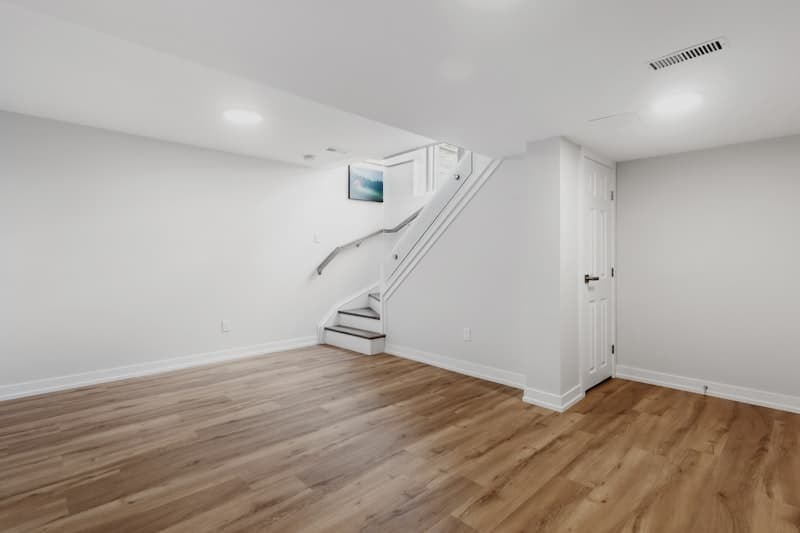
Why Lawrence Township Basements Are Different
Lawrence Township sits on some of the most variable soil in Mercer County. Depending on which neighborhood your home is in, you could be dealing with dense clay that holds water against your foundation for weeks after rain, or sandy loam that drains well but shifts with seasonal freeze-thaw cycles. The housing stock ranges from 1950s ranch homes with poured concrete foundations to 1980s colonials with block walls to 1990s split-levels with walk-out lower levels. Each presents different challenges and different opportunities when it comes to finishing a basement.
Generic basement finishing guides do not account for any of this. They give you national averages and generic checklists. This guide is built for Lawrence Township specifically — the soil conditions, the home types, the neighborhoods, the permit process, and the real costs that homeowners here face in 2026.
If you have an unfinished basement in Lawrence, you are sitting on 500-1,500 square feet of usable space that costs a fraction of what a home addition would. Finishing it is one of the highest-ROI renovations you can make in this market. But doing it right in Lawrence means understanding the local conditions first.
Neighborhood-by-Neighborhood Basement Analysis
Lawrenceville Village
The historic core of Lawrenceville, centered around Main Street and the area near Lawrenceville School, has some of the oldest homes in the township. Many date to the early 1900s or earlier, with stone or rubble foundations. Basements here tend to be shallow — 6 to 7 feet of headroom — and damp. The water table in the village is relatively high due to the topography and proximity to Shabakunk Creek.
Key considerations: - Stone and rubble foundations require specialized waterproofing — not just interior drainage but sometimes exterior excavation and membrane application - Low ceiling heights may disqualify some basements from code-compliant living space (NJ requires 7 feet minimum, 6 feet 8 inches under beams) - Older homes may have oil tank concerns — always test before finishing - Historic character can limit exterior modifications for waterproofing
Moisture risk: High. Budget for comprehensive waterproofing.
Quaker Bridge Corridor
The neighborhoods flanking Quaker Bridge Road, from Route 1 east toward the Mercer County Park, were built primarily in the 1970s and 1980s. These are predominantly colonial and bi-level homes with concrete block foundations. Block foundations are porous by nature — water migrates through the mortar joints, especially during heavy rain and snowmelt.
The soil along the Quaker Bridge corridor is a mix of clay and silt. It holds moisture well, which is bad news for basements. Many homes in this area already show efflorescence (white mineral deposits) on the interior block walls, which is a clear indicator of moisture migration.
Key considerations: - Block wall waterproofing is essential — interior drainage systems with a sump pump are the standard approach - Most homes have 8-foot basement ceilings, which gives comfortable headroom after finishing - HVAC ductwork commonly runs through the basement ceiling, requiring creative soffit design or duct relocation - Many homes have existing sump pumps that may need upgrading or battery backup before finishing
Moisture risk: Moderate to high. Interior waterproofing system recommended for most homes.
Cold Soil Road Area
The Cold Soil Road corridor and the developments branching off it (Darrah Lane, Whitehead Road, and surrounding streets) are home to many of Lawrence's mid-century ranch homes. These 1950s and 1960s ranches have poured concrete foundations that are generally in good condition but often lack modern waterproofing.
The soil in this area gives the road its name — it is heavy clay, dense and cold, and it holds water like a sponge. After spring rains, basements in the Cold Soil Road area are among the most likely in Lawrence to show seepage at the floor-wall joint. This is the single most common water entry point in poured concrete basements and it is addressable with an interior perimeter drainage system.
Key considerations: - Heavy clay soil means exterior drainage improvements alone are insufficient — you need an interior system - Ranch basements in this area are typically 7-8 feet in ceiling height, workable but tight - Many homes have original cast iron sewer lines that should be inspected (camera scope) before finishing - Radon levels in this part of Lawrence tend to test above the EPA action level of 4 pCi/L — radon mitigation should be installed during finishing, not after
Moisture risk: High. Full interior waterproofing with battery-backup sump pump is the minimum standard.
Eggerts Crossing
The Eggerts Crossing area, east of Route 206 and south of Eggerts Crossing Road, was developed primarily in the 1960s and 1970s. Homes here are a mix of ranches, split-levels, and early colonials. Foundations are predominantly poured concrete with some block construction.
This area sits at a slightly higher elevation than the Cold Soil Road neighborhoods, and the soil has more sand content. Basements here tend to be drier than the Cold Soil and Lawrenceville village areas, though seepage at the floor-wall joint is still common during sustained rainfall.
Key considerations: - Moderate moisture conditions make this area more favorable for basement finishing - Split-level homes often have partial walk-out basements, reducing moisture issues on the exposed side - Many homes have daylight exposure on one or two walls, which simplifies egress window requirements - The mix of ranch and split-level construction means varied ceiling heights — measure before planning
Moisture risk: Moderate. Interior drainage may be needed; some homes can get by with targeted sealing and proper grading.
Route 206 Corridor and Newer Developments
Homes built after 1990, particularly in developments along Route 206 and in the northern part of the township near the Princeton border, generally have better baseline waterproofing. Builders started incorporating exterior damp-proofing, perimeter drains, and sump pits as standard practice by the mid-1990s.
Key considerations: - Newer foundations are generally in good condition with existing sump infrastructure - 8-9 foot basement ceilings are common, giving excellent headroom - Many newer homes have basement rough-ins (plumbing stubs, electrical panel capacity) that reduce finishing costs - Less likely to need radon mitigation, though testing is still mandatory before finishing
Moisture risk: Low to moderate. Existing systems may be sufficient; test and verify before committing.
Waterproofing: The Non-Negotiable First Step
In Lawrence Township, no basement finishing project should begin without addressing moisture. This is not optional — it is the foundation of the entire project, literally and figuratively. Skipping waterproofing to save money is the most expensive mistake you can make. A finished basement with a moisture problem becomes a mold problem, and a mold problem becomes a tear-out-and-start-over problem.
Interior Waterproofing Systems
The standard approach for Lawrence basements is an interior perimeter drainage system. This involves:
- Perimeter trench — A channel cut into the concrete floor along the foundation walls, 6-8 inches wide and 8-12 inches deep
- Drain tile — Perforated PVC pipe laid in the trench, sloped toward the sump pit
- Gravel bed — Clean stone surrounding the drain tile for filtration
- Vapor barrier — A dimple mat or membrane on the walls to direct water down to the drainage channel
- Concrete cap — The trench is covered with new concrete, leaving the system invisible once finished
- Sump pump — Primary pump plus battery backup, discharging to exterior grade away from the foundation
Cost for interior waterproofing in Lawrence: - Perimeter drainage system (full perimeter, ~130 linear feet for a typical ranch): $6,000-$10,000 - Partial perimeter (problem areas only): $3,000-$6,000 - Sump pump with battery backup: $1,500-$3,000 - Wall vapor barrier: $1,500-$3,000 - Total waterproofing: $8,000-$15,000 depending on scope
Exterior Waterproofing
For severe moisture issues — particularly in Lawrenceville village homes with stone foundations — exterior waterproofing may be necessary. This involves excavating around the foundation, applying a waterproof membrane, and installing or replacing the exterior French drain.
Cost: $15,000-$30,000 for full exterior waterproofing. This is a major job and is only warranted when interior systems cannot solve the problem.
Radon Mitigation
Mercer County is in EPA Radon Zone 2, which means moderate radon potential. However, actual readings vary dramatically by neighborhood and even by individual lot. Lawrence Township homes along Cold Soil Road and in the Lawrenceville village area frequently test above the 4 pCi/L action level.
A radon mitigation system installed during basement finishing costs $800-$1,500. The same system installed after finishing costs $1,500-$3,000 because the contractor has to work around your completed space. Test first, mitigate during construction.
NJ Egress Code Requirements
New Jersey adopted the International Residential Code (IRC) egress requirements, which apply to any basement room used as a sleeping area. Even if you do not plan a bedroom now, meeting egress code gives you flexibility later and is required for any room that could be used for sleeping.
Egress Window Requirements
- Minimum opening area: 5.7 square feet
- Minimum opening width: 20 inches
- Minimum opening height: 24 inches
- Maximum sill height: 44 inches from the finished floor
- Window well: Required when the window is below grade. Minimum 9 square feet of floor area, minimum 36 inches wide. Must have a permanent ladder or steps if the well is deeper than 44 inches.
Egress Window Costs in Lawrence
Installing an egress window in a Lawrence Township basement involves cutting through the foundation wall (poured concrete or block), excavating the window well, installing the window and well liner, and waterproofing the new opening.
- Egress window installation (concrete cutting, window, well, drainage): $3,500-$6,000 per window
- Window well cover (recommended for NJ weather): $200-$500
Most Lawrence basements need one egress window for a conforming bedroom. If you are creating a full in-law suite with two bedrooms, plan for two egress windows.
Ceiling Height Requirements
NJ code requires a minimum 7-foot ceiling height in finished basements, with a minimum 6 feet 8 inches under beams, ducts, and soffits. This is where many Lawrence ranch basements get tight. If your unfinished basement has 7.5 feet of headroom, you lose about 1.5-2 inches to flooring and another 0.5-1 inch to drywall on the ceiling. Ductwork soffits can drop another 8-14 inches in the areas they cross.
Solutions for tight ceiling heights: - Route ductwork to minimize soffit area and keep the main space at full height - Use recessed lighting instead of surface-mount fixtures - Use engineered flooring or LVP (thinner profile than tile on cement board) - Consider a flush baseboard heater instead of HVAC runs in tight areas
Basement Finishing Costs in Lawrence Township
Basic Finish: $25,000 - $40,000
A basic finish for a 1,000-square-foot Lawrence basement covers the essentials — clean, code-compliant living space with standard materials.
Cost breakdown: - Waterproofing (interior perimeter system): $6,000-$10,000 - Framing (2x4 walls, standard layout): $3,500-$5,500 - Insulation (rigid foam or spray foam on foundation walls): $2,000-$4,000 - Drywall (hang, tape, finish): $4,000-$6,000 - Electrical (outlets, switches, lighting, smoke/CO detectors): $3,000-$5,000 - LVP or carpet tile flooring: $2,500-$4,500 - Paint and basic trim: $1,500-$2,500 - Permits and inspections: $500-$1,000
Does not include: Bathroom, egress window, HVAC extension, or specialty finishes.
Mid-Range Finish: $40,000 - $55,000
The mid-range finish adds a half bathroom, an egress window, HVAC extension, and upgraded materials.
Cost breakdown: - Everything in basic finish: $25,000-$40,000 - Half bathroom (toilet, vanity, tile floor): $5,000-$8,000 - Egress window installation: $3,500-$6,000 - HVAC extension (ductwork, register, return): $2,000-$4,000 - Radon mitigation (if needed): $800-$1,500 - Upgraded lighting (recessed cans, dimmer switches): $1,000-$2,000 - Better flooring (engineered hardwood or large-format tile): $1,500-$3,000
Premium Finish: $55,000 - $70,000
A premium basement finish in Lawrence creates a true living suite — full bathroom with shower, wet bar or kitchenette, built-in entertainment area, and high-end finishes throughout.
Cost breakdown: - Everything in mid-range finish: $40,000-$55,000 - Full bathroom with tiled shower: $8,000-$12,000 (above the half bath) - Wet bar or kitchenette (sink, mini fridge, cabinets): $4,000-$8,000 - Built-in entertainment center or shelving: $2,000-$5,000 - Upgraded trim, wainscoting, or accent wall: $1,500-$3,000 - Soundproofing (isolation clips, resilient channel, insulation): $1,500-$3,000 - Smart lighting and audio pre-wire: $1,000-$2,500
Ranch vs. Colonial vs. Split-Level Basement Differences
Ranch Basements
Ranch basements in Lawrence typically run the full footprint of the house — 800-1,200 square feet. The ceiling height is usually 7.5-8 feet, which is workable but tight. The advantages of ranch basements are simple access (usually an interior staircase from the main floor), full-perimeter foundation for consistent waterproofing, and a single level that is easy to design.
The challenges: lower ceilings, ductwork that runs through the center of the space (the main trunk line), and often only one or two small windows for natural light. Budget for soffits around ductwork and at least one egress window.
Colonial Basements
Colonial basements in the Quaker Bridge corridor and Princeton Pike area tend to have slightly more headroom — 8 feet is common in 1980s construction. The basement footprint matches the first floor, often 1,000-1,400 square feet. Colonials typically have the HVAC system and water heater in the basement, which takes up 60-100 square feet that cannot be finished.
The advantage of colonial basements is usually better access to exterior walls for egress windows and more flexible layouts around the mechanical area. The challenge is that block wall construction is more moisture-prone than poured concrete.
Split-Level Basements
Split-level homes in Lawrence have the most interesting basement situations. The lower level is often partially above grade, which means natural light and potentially a walk-out door. This dramatically reduces moisture concerns on the above-grade wall and provides built-in egress without cutting a window.
The disadvantage is that split-level basements are often smaller — 500-800 square feet — because only part of the home sits above the lower level. The ceiling height can also vary where the upper and lower levels connect.
Best Uses for a Finished Lawrence Basement
Home Office
With remote and hybrid work now permanent for many Lawrence residents who commute to Princeton, Trenton, or Philadelphia, a basement home office is one of the highest-value uses. A dedicated office space with proper lighting, electrical, and climate control adds both daily utility and resale appeal.
Entertainment and Media Room
The basement is the natural location for a home theater or entertainment space. Below-grade rooms are quieter, darker, and easier to climate-control. Soundproofing a basement ceiling (to prevent noise from traveling upstairs) adds $1,500-$3,000 but makes a significant difference.
Guest Suite or In-Law Apartment
A basement bedroom with a full bathroom and egress window creates a private guest suite. For Lawrence families with aging parents or college-age children, this is one of the most requested layouts. NJ code requires the egress window and a smoke detector with CO alarm for any sleeping room.
Home Gym
The structural slab floor of a basement handles heavy equipment without subfloor concerns. Climate control is straightforward, and the space is naturally cooler in summer. A basic gym setup requires dedicated electrical circuits for equipment and good ventilation.
Rental Income (ADU Potential)
While New Jersey's Accessory Dwelling Unit (ADU) regulations are evolving, a code-compliant basement apartment with separate entrance, kitchen, bathroom, and egress is increasingly valuable. Even if you do not rent it immediately, building to ADU standards preserves the option.
Lawrence Township Permit Requirements
Basement finishing in Lawrence requires a construction permit from the Lawrence Township Building Department. The department is located at the Municipal Building, 2207 Lawrenceville Road. For general NJ permit guidance, see our NJ renovation permits guide.
Required permits: - Construction/building permit (framing, general construction) - Electrical sub-permit (all wiring, outlets, lighting) - Plumbing sub-permit (if adding a bathroom or wet bar) - Fire sub-permit (smoke detectors, CO alarms)
Permit fees: Based on the estimated project cost. Expect $500-$1,500 total for a typical basement finishing project.
Inspection sequence: 1. Rough framing inspection (before insulation and drywall) 2. Rough plumbing inspection (if applicable) 3. Rough electrical inspection 4. Insulation inspection 5. Final inspection (after all finishes are complete)
Timeline: Permit approval takes 2-4 weeks for standard basement finishing. Projects with egress windows or structural modifications may take longer due to plan review requirements.
Common Mistakes Lawrence Homeowners Make
Skipping Waterproofing
We said it at the top and we will say it again: waterproofing is not optional in Lawrence. The clay soil, the water table, and the age of most foundations in this township mean moisture is a matter of when, not if. Every dollar you save by skipping waterproofing will cost you $3-$5 in remediation when moisture problems surface inside your finished space.
Using Moisture-Sensitive Materials
No paper-faced drywall below grade — use moisture-resistant (green board) or paperless (DensArmor) drywall. No carpet directly on concrete — use LVP, tile, or engineered flooring with a moisture barrier. No wood studs directly against the foundation — use a rigid foam barrier or leave a gap between the stud wall and the foundation.
Ignoring Radon
Radon testing is cheap ($15 for a home test kit, $150-$300 for a professional test). Radon mitigation during construction is $800-$1,500. Radon-related health problems are not cheap. Test before you finish, mitigate during construction.
Underestimating HVAC Needs
A finished basement needs heating and cooling. Extending your existing HVAC system is the most common approach, but it only works if your furnace and AC have enough capacity. An undersized system will leave the basement cold in winter and hot in summer while reducing performance on the upper floors. Have your HVAC contractor evaluate capacity before committing to duct extension.
Ready to Finish Your Lawrence Basement?
Your basement is already there, already paid for, and already sitting empty. Finishing it gives you the space you need without the cost, disruption, and permit complexity of a home addition. In Lawrence Township, where lot sizes make additions difficult in many neighborhoods, the basement is often the only option for meaningful square footage gains.
At The5thwall, we are Stefanos and Tony Karpontinis — a father-and-son team based in Lawrence Township. We have finished basements across every neighborhood covered in this guide, from the ranch homes on Cold Soil Road to the colonials along Quaker Bridge corridor. We handle everything — waterproofing, framing, electrical, plumbing, permits, inspections, and final finishes.
We are NJ licensed (HIC #13VH04175700), carry $2M insurance, and we never start finishing until the waterproofing is done right. Period.
Call us at (762) 220-4637 or fill out our contact form to schedule a free basement evaluation. We will assess your moisture conditions, measure your space, and give you an honest number for what your specific basement will cost to finish. Learn more about our basement finishing services or check out our detailed basement finishing cost guide for NJ for more pricing information. We proudly serve the entire Lawrence Township area.